
Front yard landscaping ideasyou can test with AI before you dig
See exactly what different landscaping styles look like on your actual home. No plant shopping, no digging, no expensive mistakes.
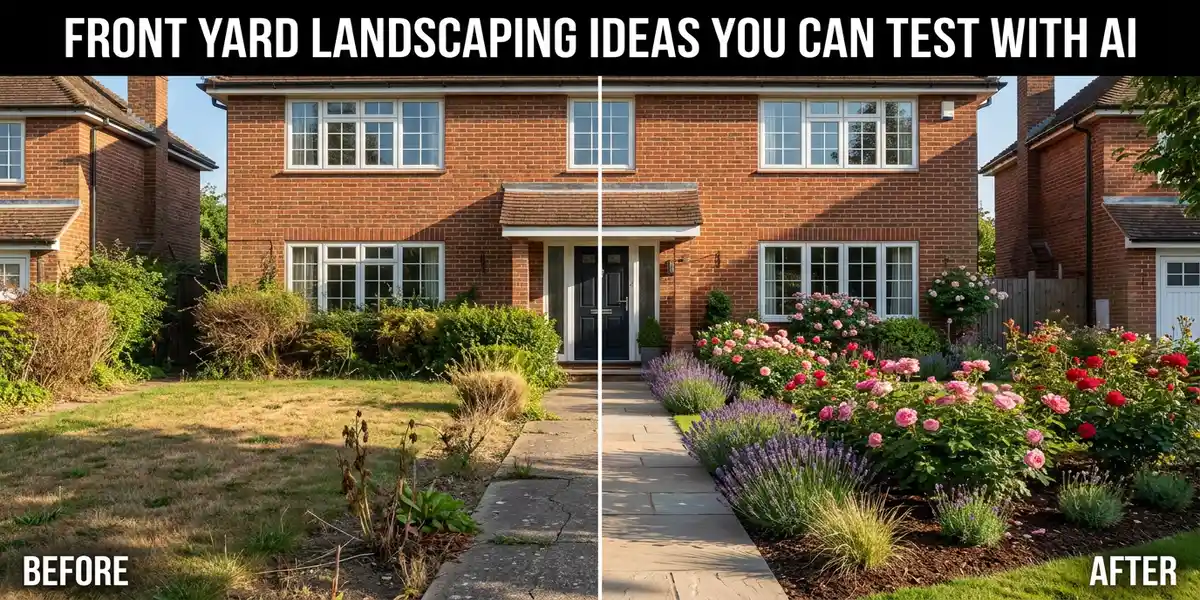
The front yard is the first thing anyone sees. Most people ignore it for years anyway — not because they don't care, but because deciding where to start feels impossible.
You're not sure which style fits your house. You don't know what survives your winters. You go to the garden center for mulch and come home with $350 in plants that don't actually work together.
That happened to me. I bought a flat of ornamental grasses because they looked good in the store display, brought them home, and realized they were completely wrong for my traditional brick house. Took me another season to fix it.
AI solves this by letting you see results on your actual home before spending anything. Upload a photo, pick a style, and get a photorealistic render back. Last spring I tested seven styles on my front yard in about 20 minutes. The cottage garden version looked right on the first try. The modern minimalist version — which I was convinced I wanted — looked totally wrong against my brick facade.
Ten front yard styles worth testing on your home
These are the styles in AITWO's landscape tool. I've tested most of them myself. Below is what each one actually looks like and who it works for.
1. Cottage garden
Roses, lavender, foxglove, climbing vines — all layered and slightly wild-looking. This is the style that worked for my brick house. It felt natural against the older architecture. You'll spend some weekends deadheading and pruning, but it blooms from May to September without much else from you.
2. Modern minimalist
Gravel, ornamental grasses, one or two specimen plants. Clean and sharp. No mowing, almost no watering once it's established. Works well on flat-roof or mid-century homes. If your house has a lot of detail and ornamentation, this style will look stripped down in a bad way.
3. Native wildflower
Local wildflowers and native grasses that cut water use by 50% to 75% versus a standard lawn. The AI render helped me see something I wouldn't have figured out on my own: this style only works if your property has some setback from the street. Right on the curb it reads as unkempt. Thirty feet back, it looks intentional.
4. Formal traditional
Symmetrical beds, boxwood hedges, clipped topiaries, standard roses. Gorgeous on a Georgian colonial. The most expensive style to maintain — boxwood alone needs shaping twice a year, and a professional trim runs $150 to $300 per visit. Budget for that before you commit.
5. Mediterranean
Terracotta pots, lavender, rosemary, drought-tolerant shrubs. Looks right on stucco or Spanish-style homes. It works in USDA zones 8-11. If you're in zone 6 or colder, you'd swap the olive trees for Russian sage or another cold-hardy alternative — the AI tool will flag this automatically if you enter your location.
6. Xeriscape / desert
Gravel, succulents, agave, ornamental rocks. Zero irrigation once established — saves roughly 50 to 75 gallons of water per 1,000 square feet per week versus a lawn. Best in zones 7-11. I tried this render on a friend's ranch-style home in Phoenix and it looked like a magazine cover.
7. English country
Like cottage but with more structure — defined bed borders, perennials in planned groupings, climbing roses on trellises. Softer than formal traditional. Good middle ground if you want something polished but not rigid. Needs regular watering and some deadheading through summer.
8. Zen Japanese
Stone paths, bamboo, moss, raked gravel, low evergreens. Nearly zero water use. The render surprised me here — this style actually looked good on every home type I tested it on, because the simplicity is neutral. The catch: the hardscape is the expensive part. Stone and gravel installation runs $15 to $25 per square foot.
9. Tropical paradise
Palms, bird-of-paradise, hibiscus, large-leaf cannas. Genuinely beautiful but only practical in zones 9-11. If you're in a colder zone and still want the vibe, hardy banana and elephant ear can get you close — just know they'll need mulching or digging up before frost each year.
10. Foundation planting redesign
Just swapping the plants along your house — nothing else. Best return on investment of any front yard project. Overgrown junipers blocking windows are probably the single most common curb appeal problem in American suburbs. I've seen renders where removing them and replanting with correctly-sized shrubs shaved 10 years off how the house looks.
How to choose the right style for your home
Don't pick based on what looks good on someone else's Instagram. That coastal cottage in Santa Barbara won't translate to a suburban colonial in Ohio. Three things actually determine what works: your home's architecture, your climate zone, and how many hours per month you're willing to spend maintaining it.
| Your home style | Best matches | Avoid |
|---|---|---|
| Contemporary / modern | Modern minimalist, Zen Japanese, Xeriscape | Cottage, English country |
| Traditional / colonial | Formal traditional, English country, Cottage | Tropical, Xeriscape |
| Craftsman / bungalow | Cottage, Native wildflower, English country | Formal traditional |
| Spanish / Mediterranean | Mediterranean, Xeriscape, Tropical | English country, Formal traditional |
| Ranch / suburban | Native wildflower, Modern minimalist, Cottage | Formal traditional |
Run your top two or three options through the AI tool before making any decisions. The table is a starting point. Your actual house will overrule it every time — which is exactly why the render matters more than the chart.
Common mistakes that kill front yard projects
I've made a few of these myself. Others I've watched friends repeat:
- 1.Buying plants before locking in the design. Garden centers display plants at eye level precisely because it triggers impulse buys. You go in for mulch and walk out with $200 in random perennials that don't belong together. I did this twice before I learned to show up with a list from my AI render and nothing else.
- 2.Not checking mature plant sizes. The juniper at the nursery is 18 inches tall and costs $12. In 10 years it's 8 feet wide and covering your ground floor windows. Always look at the tag's mature size, not the current size. The AI tool shows plants at their correct mature scale, which is one of the most useful things about it.
- 3.Planting too close to the foundation. Foundation plants need 3 to 5 feet of clearance from the structure. Closer than that and you get trapped moisture, pest problems, and plants that look jammed in after two or three growing seasons. This is hard to fix once the plants are established.
- 4.Skipping the front path. A clear walkway from the street to your door does more for curb appeal than any plant combination. It creates a visual anchor. If your current path is cracked concrete or missing entirely, fix that before spending a dollar on plants.
- 5.Budgeting for plants, not hardscape. Plants are the cheap part. Pavers and stone are not. A flagstone path runs $15 to $30 per square foot installed. Concrete is $8 to $20. My neighbor put most of his budget into plants and ran out of money before finishing the walkway he designed around. Work out the hardscape cost first. Then plant the rest.
Connect your yard and your home's exterior
The biggest curb appeal upgrade happens when landscaping and exterior paint/siding work together. A beautiful garden in front of a dated or peeling facade still looks mismatched.
If your exterior needs work, read our guide on visualizing home exterior changes with AI to redesign siding, paint, and trim before committing. Plan both together and the result is a cohesive transformation rather than an incremental patch.
For the backyard, check our full guide on AI backyard design — the same workflow applies, with different goals since the backyard is about how you use the space, not how it looks from the street.
If you're staging the property for sale, AI landscaping pairs well with virtual room staging. A National Association of Realtors study found that staged homes sell 73% faster. Combining exterior and interior AI visualization gives you a complete picture for listing photos.
Test front yard designs on your actual home
Upload a photo of your front yard. Pick from 8 styles. See a photorealistic render of your home with new landscaping before buying a single plant.